LOGIK Health – clinical governance for skilled nursing
LOGIK Health is a clinical-governance platform for skilled nursing and residential care facilities. When a nurse notices a change in a resident, they file a structured observation. A deterministic rules engine assigns an urgency tier (Green, Yellow, Enhanced Yellow or Red), and the platform routes the event to the right clinician, escalates it on a timed ladder if no one responds, and records every step in an auditable ledger. The goal is simple and high-stakes: a resident whose condition is getting worse should never be silently missed.
I’m LOGIK’s founding engineer and engineering lead. The nursing and provider boards run on the web, and the LOGIK Health iOS app puts the same boards on the phones nurses share between shifts.

Problem
When I joined, the seed-stage startup had a mature clinical rules engine that nothing enforced and a thin proof of concept with no nursing workspace. No CI gate could block a merge, the escalation cascade had never actually fired, a single contractor was a continuity risk, and there was no path to a HIPAA-grade production environment ahead of a first pilot with a senior-care operator.
What I built
I joined in July 2026 as founding engineer for the nursing side and took over all engineering in August. I'm responsible for the whole system: the web apps, the backend API and data model, escalation and notifications, the cloud deployment pipeline, and the engineering process that keeps a safety-critical system trustworthy. The clinical rules belong to the clinical team. My job is to build the platform that enforces them faithfully, and to keep proving that it does.
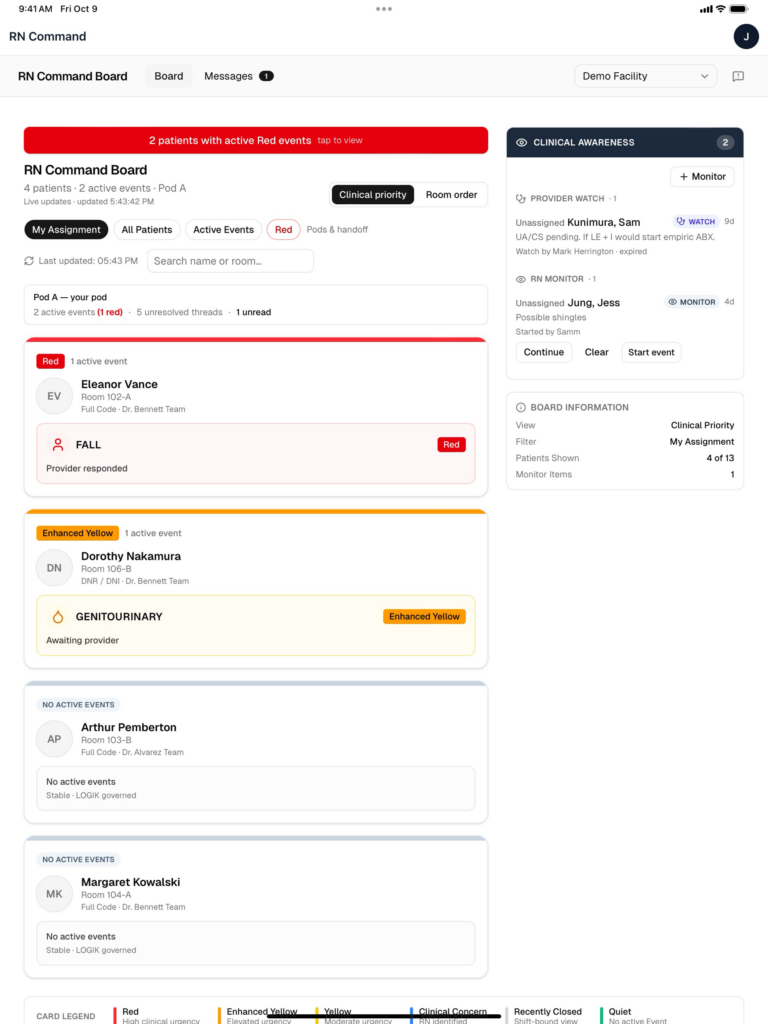
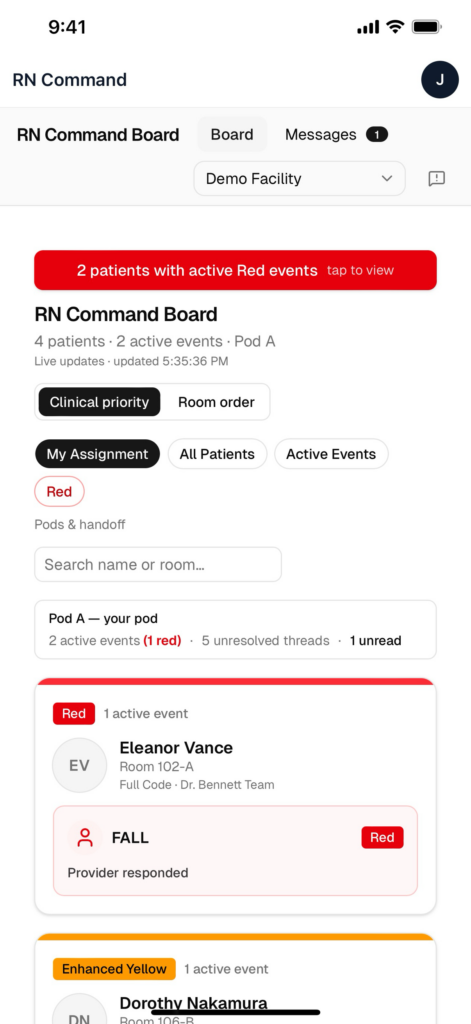
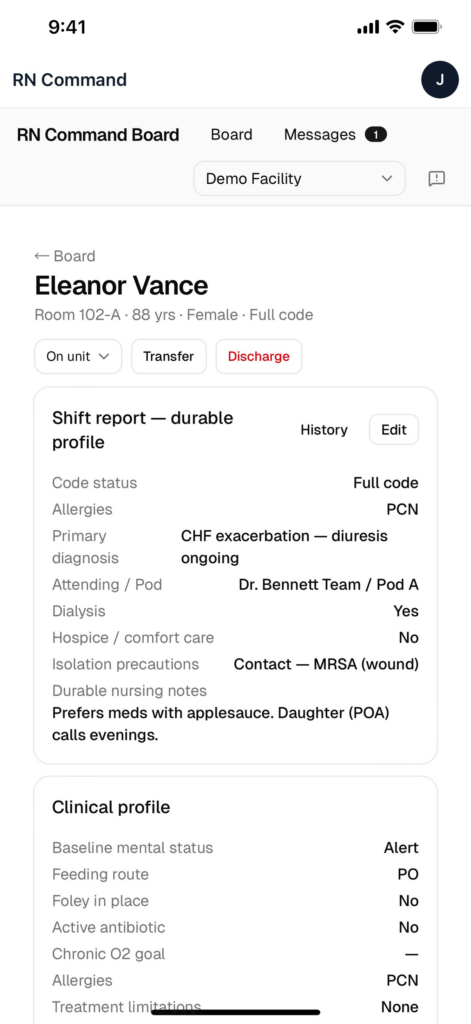
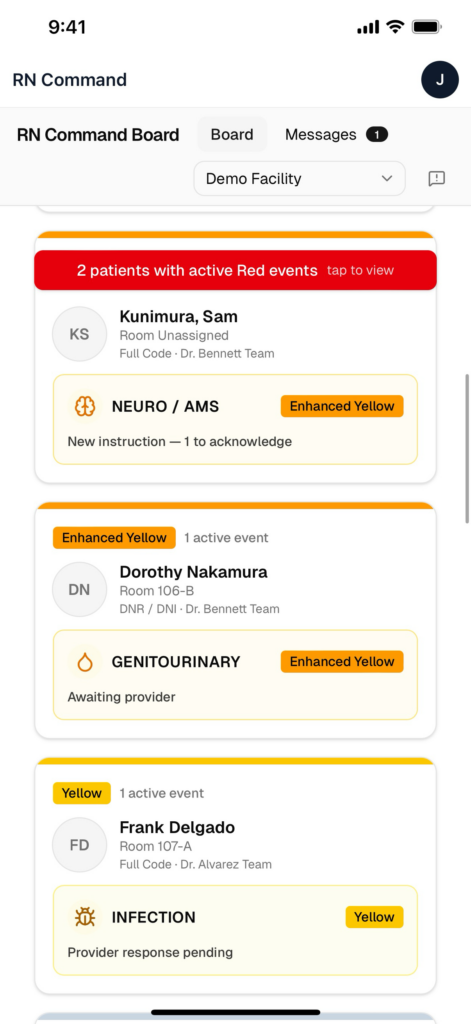
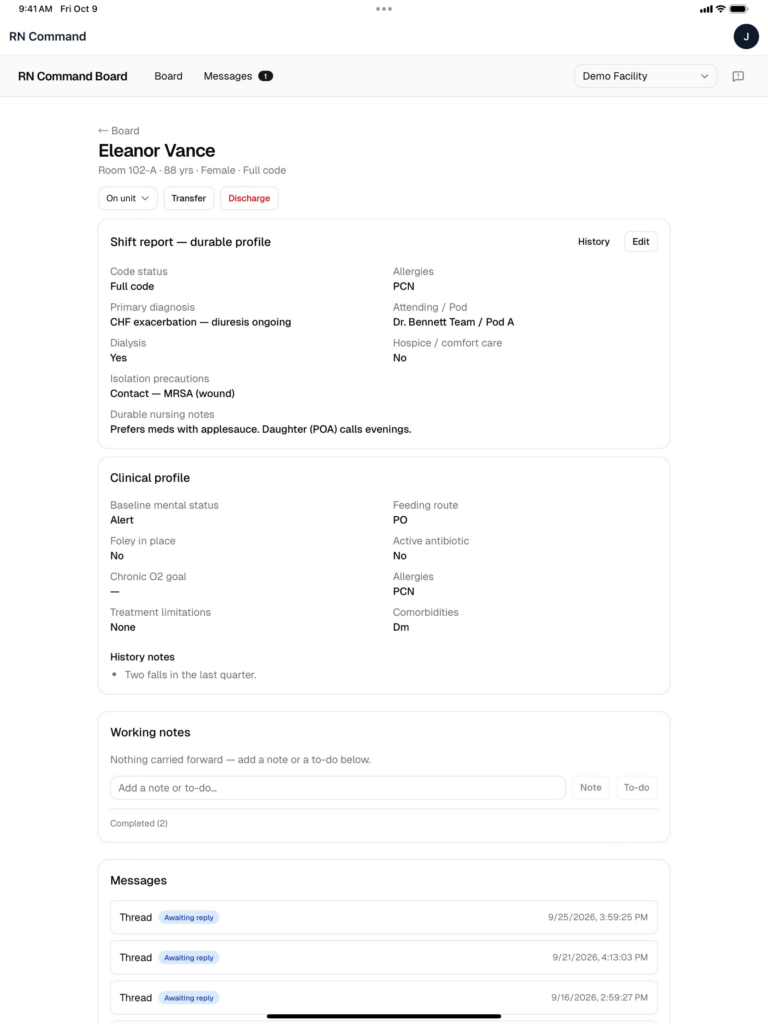
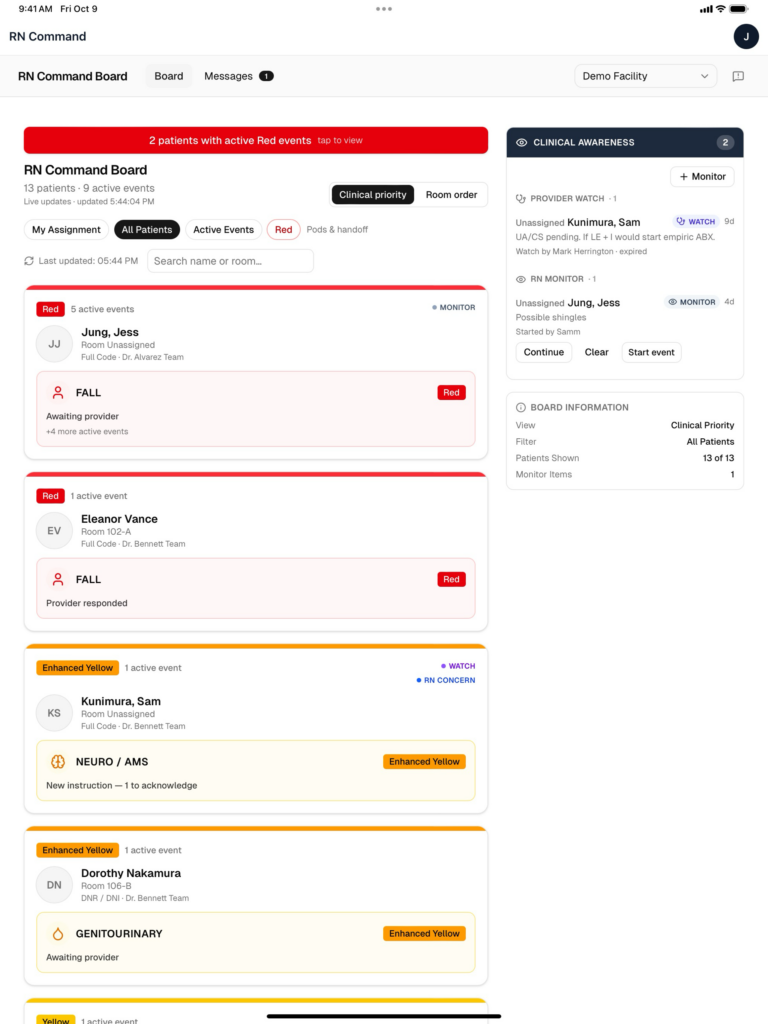
The apps. A TypeScript monorepo with role-specific React apps: an admin console, an intake board, the RN Command Board (patient status, event lifecycle, handoffs, messaging, shift notes) and the Provider Command Board (accept, assign, structured instructions with per-instruction acknowledgement), all on a NestJS API over Postgres with WorkOS sign-in. I also built the Expo mobile app for shared nursing-station phones. It asks "Welcome back" before showing the board after the phone has been set down, hides resident details in the app switcher, blocks screenshots, and lets nurses attach photos to an event, sorted as clinical or non-clinical. Red alerts break through Do Not Disturb.
A rules engine that has to agree with the clinicians. The clinical rules are deliberately deterministic, with no LLM in the loop. The clinical team writes the urgency rules in a simulator. I extract the simulator as an oracle, port its logic into typed modules, and a generated conformance harness (now around 17,000 cases) grades the engine against it. It's a required CI gate: a single disagreement blocks the merge.
Escalations that can't quietly stop. Timed escalations run as durable Temporal workflows, so an unanswered page climbs a 15, 30 and 60-minute ladder even across restarts, and a Red alert can never stop without an owner. Pages go out by SMS, web push and native push with no patient details in the payload, and the system never claims a provider was reached unless one was. Recent hardening means a comparison check that could throw can no longer block a filing, an escalation that fails to start is detected and recovered automatically, and closing an event is serialized against a provider accepting it, so an event can't end up resolved with an unanswered owner.
Compliance by construction. Every read and write of protected health information is scoped to the caller's facility and tenant through a single authorization path. On AWS, defined in CDK, I built an isolated Multi-AZ production tier, and I wrote the compliance paper trail: SOC 2 scope, security review, incident response and disaster recovery procedures, and the production-readiness checklist that gates real patient data. I also built a fair-scheduling proof of concept.
Stack
TypeScript, Turborepo, NestJS, Drizzle, PostgreSQL (RDS), Temporal, Zod, React 19, Vite, TanStack Router, Expo / React Native, WorkOS, Twilio, AWS CDK, ECS Fargate, CloudFront, CodePipeline, Infisical, Playwright, Vitest, Claude Code
Outcome
The dev environment has been live since July 31, 2026. Staging and an isolated production tier were deployed and verified on October 22, 2026, with real patient data held back until the readiness checklist was met. The pilot is now live in production at its first care home, Manoa Senior Care in Hawaii, and the iOS app launched on the App Store on November 4, 2026. The engine passes all 16,966 conformance cases at its current pin. A documented decision log ties the system's behavior back to a clinical authority rather than a guess. About 680 commits and 410 PRs in four months.